Showing posts with label ENERGY. Show all posts

Thursday, 9 March 2017

HOW CAN WE PROTECT OUR PLANET?

What problems do non-renewable energy sources cause?
Using non-renewable energy sources causes two problems:
  • First of all, these sources are limited.
  • Secondly, these sources produce pollution such as carbon dioxide and other gases that are harmful for people and the environment. Nitrogen oxide and sulphur dioxide cause global warming and acid rain.
What are the three Rs?
To take care of our planet, we should conserve energy whenever possible. We should also use renewable sources of energy as much as possible.
The three Rs protect the environment because they help us fewer resources.
  • Reduce: buy products that don't have a lot of packaging.
  • Reuse: use glass, metal and plastic containers again and again.
  • Recycle: separate rubbish and put it in the correct bin.
Picture from testeach.com

HOW ARE SOURCES OF ENERGY CLASSIFIED?

We get energy from natural sources. They can be renewable or non-renewable.
Renewable energy sources:
  • Hydroelectric energy: we get hydroelectric energy from water that is moving or falling. The water is collected in a reservoir. Then it passes through a turbine, it generates electricity.
  • Wind energy: we get wind energy from the movement of air. The kinetic energy of the wind turns a turbine, and produces electrical energy.
  • Solar energy: we get solar energy from the Sun in the form of light and heat. Solar panels transform that energy into electrical energy.
  • Biofuels: we get biofuels from plant and animal products. Biofuels are burned in power stations to produce electrical energy.
Non renewable energy sources: Non-renewable energy is energy from sources that are limited:
  • Petroleum: this black liquid forms underground from decayed plants and animals. It's the source of the fuel oil, diesel fuel and petrol that we use for heating and running vehicles. Fuel oil is also used to produce electricity in oil-burning power stations.
  • Coal: This black rock is formed underground ffrom decayed plants. Coal is used as fuel in some industries, and to produce electricity in coal-burning power stations.
  • Natural gas: is a mixture of gases that have formed from decayed living organisms. It's found underground. Natural gas is used as fuel in many industries and to produce electricity in gas-burning power stations.
  • Uranium: this radioactive metal is found in rocks. it's used in nuclear power stations to produce heat in nuclear reactions. Electricity is produced from this heat.
Picture from caulagdeverajavier.wordpress.com


HOW DO WE MEASURE THE ENERGY IN FOOD?

The chemical energy stored in food and drinks is measured in calories. The more calories in a food, the more energy it contains. Foods like nuts, red meat and cheese have a lot of calories. Vegetables and white meat, like chicken, have fewer calories.

Picture from ladycarehealth.com
Picture from peydi.blogspot.com

WHAT' HAPPENS TO ENERGY WHEN IT'S USED?

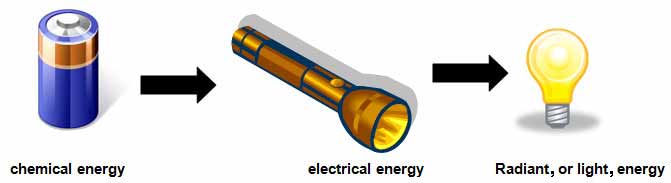
Energy never disappears, it can be transfromed from one type of energy into another, but it doesn't disappear completely.
Some common energy transformations:
  • Chemical energy: Aeroplanes and cars transform the chemical energy in fuel and petrol into kinetic and thermal energy.
  • Electrical energy: fans and electrical drills transform electrical energy into kinetic and thermal energy.
  • Light energy: Solar panels transfrom light eenrgy from the Sun into electrical energy during the day.
Picture from Texas Gateway

Monday, 20 February 2017

HOW DO THE SIX FORMS OF ENERGY DIFFER?


Chemical energy:
This energy is stored in some substances.
Chemical energy is stored in food.
Chemical energy can be stored in batteries.
Thermal energy:
This is energy in the form of heat. Thermal energy heats objects up. When an object releases thermal energy, it cools down.
Light energy:
This is energy in the form of light. The Sun is a natural source of light energy.
Electrical energy:
This is energy in the form of electricity. Electricity travels to homes and factories in the through metal cables.
Nuclear energy:
This type of energy is stored in the atomic structure of all matter. Scientists release this energy by breaking down radioactive materials (uranium). In nuclear power stations, nuclear energy is transformed into the electrical energy that we use.

HOW MANY FORMS OF ENERGY ARE THERE?

Energy appears in many forms and is used in different ways. The main forms of energy are: mechanical, chemical, electrical, thermal, light and nuclear.
Mechanical energy:
Energy that produces movement is called mechanical energy. It's the energy that enables people and things to move, go faster or change direction.
We also use mechanical energy to change the direction that an object is travelling in.
What types of mechanical energy are there?
There are two types of mechanical energy: kinetic energy and potential energy.
Kinetic energy: this is energy in the form of movement.
Potential energy: this is energy in the form of potential movement, when tou lift an object, you give it potential energy.